Sunday, January 3, 2016

Epiphany Feast 2016

I had half a bottle of Rose wine left over from the holidays and didn't know what to do with it.  I asked a group of Catholic Foodies if they had a good recipe using Rose wine and someone gave this to me:


I adapted the recipe a bit and this is what I came up with.  I just need to think of a clever name for it.

1/4 c. butter
1/4 c. flour
2 tsp. salt
1/4 tsp. pepper
1/4 tsp. ground nutmeg
2 boneless, skinless chicken breasts
1 c. heavy cream
1/3 c. Rose wine
1/2 tsp. dried thyme
1/4 tsp. onion powder

  1. Cut the chicken breasts into strips, then dredge in flour, salt, pepper, and nutmeg.
  2. Brown the chicken in the butter over medium heat.
  3. Stir in wine to deglaze the pan, followed by the cream, thyme, and onion powder.
  4. Heat to boiling, then reduce heat to low and simmer for 15 minutes.
  5. Serve over pasta or rice.
I served haricot verts sauteed with shallots on the side to finish off our Epiphany luncheon feast!


Here is the saucy goodness as it simmered!

The completed product.  Yum!
And to help you all celebrate today's Feast day, here's a beautiful video for you to enjoy:


Monday, July 20, 2015

Pilgrimage Stop #2: Mission Basilica San Diego de Alcala


Mission Basilica San Diego de Alcala was the first of the California Missions.  It was founded in 1769 by Blessed Junipero Serra and named after St. Didacus.  It is an active parish, with regularly scheduled liturgies. The San Diego Padres baseball team was named after the hometown Mission.


This Mission is known for its "wings" and its distinctive bell tower (campanario).


This cross marks the site where Padre Luis Jayme was martyred.


The boys enjoyed touring the Mission grounds.


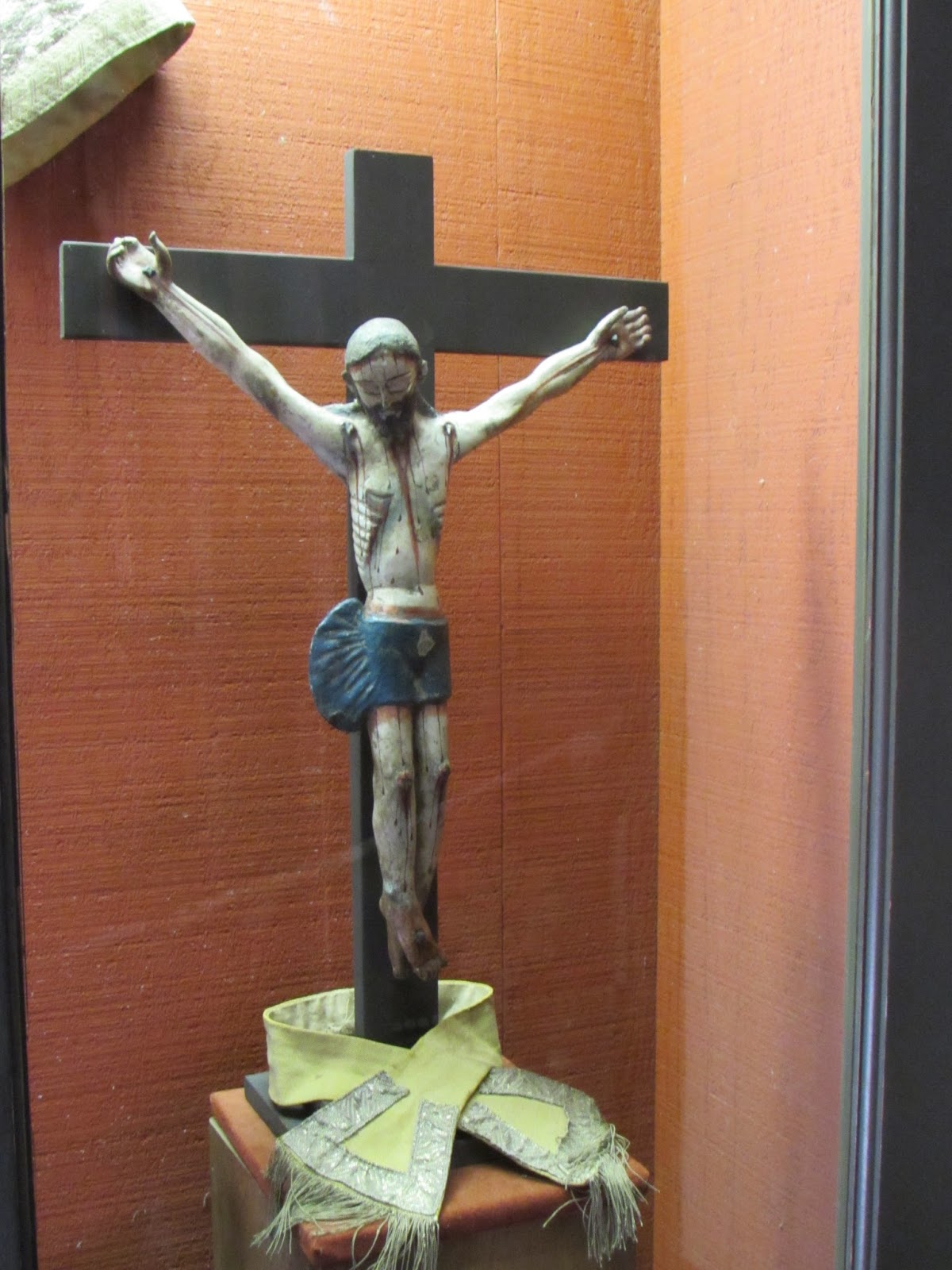
Being Good Friday, this stunning sculpture helped to remind us of the significance of Christ's sacrifice.


The Mission grounds and museum contained numerous artifacts.


Like the church at Mission San Luis Rey, the church was decorated in the original Spanish style.


The gardens included beautiful native plants, flowers, lizard friends, and statues.  Each of the 21 Missions displays a statue of Blessed Saint Junipero Serra.


 Family Pilgrimage Selfie #2:


Mission Basilica San Diego de Alcala is located at 10818 San Diego Mission Road, San Diego, CA 92108.
10818 San Diego Mission Road
San Diego, CA 9210810818
10818 San Diego Mission Road
San Diego, CA 92108

Pilgrimage Stop #1: Mission San Luis Rey de Francia


We began our pilgrimage with a visit to Mission San Luis Rey de Francia.  We drive on the highway that leads to the Mission frequently, but have never stopped there.


Mission San Luis Rey currently serves as a retreat center run by the Franciscan Friars from the Province of St. Barbara.  It was founded in 1798 by Padre Fermin Francisco de LaSuen and named after St. Louis IX, King of France.  It is often referred to as the "King of the Missions."

Because it was Good Friday, we were unable to tour the museum, but there was plenty to see on the Mission grounds.  The church was massive and lavishly decorated.


The Mission's beautiful garden features the oldest pepper tree in California, which was a unique bit of trivia.


The Mission also houses a large cemetery.


Unfortunately, because this mission is a retreat center run by a religious order, liturgies are not always open to the public.  However, the Mission has a sister parish, where you can attend Mass.

I have to say that when our pilgrimage had been completed, this ended up being one of my favorite Missions.  I look forward to returning someday so that we can visit the museum.


Here is Family Pilgrimage Selfie #1:


Mission San Luis Rey de Francia is located at 4050 Mission Avenue, Oceanside, CA 92057

The Fathers Speak


https://johnjimenez.selz.com/item/54f77644b798720ef0758447?mode=edit


The Fathers Speak: Catholic Doctrine from the Mouths of the Earliest Christians

This e-book, written by my husband, is a compilation of direct quotes from the Fathers of the Church, a "cheat sheet," if you will, of Catholic doctrine from the first 500 years of Christianity. It is available for a donation by clicking the link above and all proceeds will be used to start Aquinas Academy (aquinasacademy.weebly.com), a classical Catholic educational program. If sufficient funds are not collected to launch the program, all funds collected will be donated to the Norbertine Sisters in Tehachapi, CA, and pro-life charities.

California Missions Pilgrimage


Since my husband is was a 4th grade teacher and we're both California natives, we have talked about visiting all 21 California Missions for years.  Over the course of our marriage, we managed to visit Mission San Diego de Alcala, Mission San Juan Capistrano (our local Mission), Mission San Buenaventura, Mission La Purisima, Mission Santa Ines, Mission San Miguel, Mission San Francisco de Asis, Mission San Rafael, and Mission San Francisco Solano.


Since our oldest son will be entering 4th grade in the fall, we felt that this year would be the perfect opportunity to make our pilgrimage.  We were able to visit all 21 Missions over 8 days during Holy Week and Easter Week.

Day 1 (We live in Orange County, so we spent the night at home)

Day 2 (Holy Saturday)
  • Mission San Gabriel Arcangel
  • Mission San Fernando Rey de Espana
  • Mission San Buenaventura
  • Mission Santa Barbara

Day 3 (Easter Sunday)
  • Mission Santa Barbara (Mass)

Day 4 (Easter Monday)
  • Mission Santa Ines (Mass)
  • Mission La Purisima
  • Mission San Luis Obispo

Day 5 (Easter Tuesday)
  • Mission San Miguel Arcangel
  • Mission San Antonio de Padua
  • Mission Nuestra Senora de la Soledad

Day 6 (Easter Wednesday)
  • Mission San Carlos Borromeo de Carmelo (AKA Mission Carmel) 
  • Mission San Juan Bautista
  • Mission Santa Cruz 

Day 7 (Easter Thursday)
  • Mission Santa Clara
  • Mission San Jose

Day 8 (Easter Friday)
  • Mission San Francisco de Asis (Mass)
  • Mission San Rafael Arcangel
  • Mission San Francisco Solano

All the Missions are about 45-60 minutes apart, so it was easy to visit 3 per day.  Most are active parishes, but two of them (Missions La Purisima and San Francisco Solano) are state parks.  The majority of them charge admission for the tour/museum.  However, at some missions, if you attend morning Mass, they will allow you to stay and tour the church and surrounding grounds without paying admission.

We also made sure to take a family photo at each Mission to document our trip.  Some turned out better than others.  =)

Our family at Mission San Juan Capistrano on Divine Mercy Sunday

As soon as we left the motel or campground in the morning, our family went into pilgrimage mode.  We drove in silence, talked as a family, and listened to Glory Stories or CDs from Lighthouse Catholic Media.  At every Mission, we prayed a pilgrimage prayer (Our Father, Hail Mary, Glory Be, Apostle's Creed, and invoking the intercession of the Mission's patron saint).  Once we left the final Mission of the day, we reverted into road trip mode and listened to music and let the boys watch DVDs or play with the tablet as we drove to our destination for the night.  Throughout the trip, my husband read The Story of Junipero Serra: Brave Adventurer (Famous Lives) to the boys.

Wednesday, May 21, 2014

Catholicism and Evolution - a resource for homeschoolers


This is a project my husband is working on. Please let us know what you think. He's hoping to publish it as a short e-book or as a print pamphlet. 

All material is (c) 2014 John Jimenez 


Introduction

One of the great challenges for Catholic homeschooling families, and Catholic educators in general, is how to handle the topic of the Theory of Evolution.  There are plenty of secular approaches to the topic, but they usually accept the theory uncritically, and give it an atheistic slant.  This, of course, is not only bad theology and totally unacceptable to a Catholic, it is also bad science.
            Many Christian approaches to the Theory of Evolution set it up as diametrically opposed to God, and therefore, it and its adherents are anathema.  Or they ignore the issue altogether.  Both of these approaches are problematic as well.  The former is inconsistent with the Church’s approach, which allows great intellectual freedom on the issue (within certain guidelines given us by Revelation).  And the latter leaves children unprepared to defend their faith.  When they are confronted with the theory, they sometimes assume they were not taught it particularly because it is a threat to the Faith.
            Though there surely are good resources available, they are hard to find.  The purpose of this booklet is to provide Catholic parents a supplement to their regular science curriculum, for the purpose specifically of dealing with the Theory of Evolution.
            The first goal of this program is to break apart the false dichotomy of “evolution vs. God.”  There are certain dogmatic statements the Church has made regarding the origin of man, which God has revealed (and which, incidentally, science has confirmed).  These are to be adhered to.  However, because the Church acknowledges the validity of wide differences of opinion regarding evolutionary theory, this program does as well. 
            The truth is that evolutionary theory does not undermine a belief in God, the divinity of Christ, or the Catholic Church as His Body.  Students will be encouraged to recognize that, so they need not be afraid of it.  Evolution is fundamentally a question of science, not theology.
            As a question of science, evolution should not be accepted uncritically.  It is important to remember that the Church has made no dogmatic statement in favor of evolution.  To say that one’s opinion on this topic determines whether one is a “true Christian” or “orthodox Catholic” is simply false.  That is a foundational principle.
            The next goal of this program is to define the Theory of Evolution for students, which is not an easy task, as it takes many different forms and is constantly being revised.  They will learn the basic principles of the theory and the scientific history that has led to its development.
            They will even be taught some of the erroneous atheistic conclusions that many people come to, and why those conclusions are wrong and unsupported by science as well as divine Revelation.
            Students will also be presented with the many weaknesses in the Theory of Evolution.  Often students are taught to simply believe in evolution, while not learning about the many highly accomplished scientists who believe it is a fantasy.  In this program students will receive a clear understanding of the many problems with the theory.  They will be encouraged to explore evolutionary theory critically, and given the freedom to come to their own conclusions without fear that their Faith is at stake.
            These are the aims of this program.  Please supplement it with other materials that meet your family’s specific needs, and most importantly, with prayer.
                
(c) 2014 John Jimenez